The TL;DR
pCloud is the faster and more feature-complete service with a longer track record and Swiss privacy law on its side. Icedrive has a more cryptographically unusual upstart. If you want everything done well, pCloud wins. If you want zero-knowledge baked in, Icedrive deserves a real look.
Both services let you pay once and never see a renewal notice. That alone makes them outliers in an industry that lives off recurring revenue. However, pCloud’s prices are a lot more reasonable.
Security & Privacy
This is where the conversation gets genuinely interesting, because Icedrive made a choice almost nobody else in this industry made.
Most cloud storage uses AES-256, the cipher the US government picked for its own classified data. pCloud uses AES-256. Google, Apple, Microsoft… all AES-256. Icedrive uses Twofish. Is Twofish more secure than AES-256? No serious cryptographer would say so categorically. But it’s different, less common, and a deliberate differentiator.
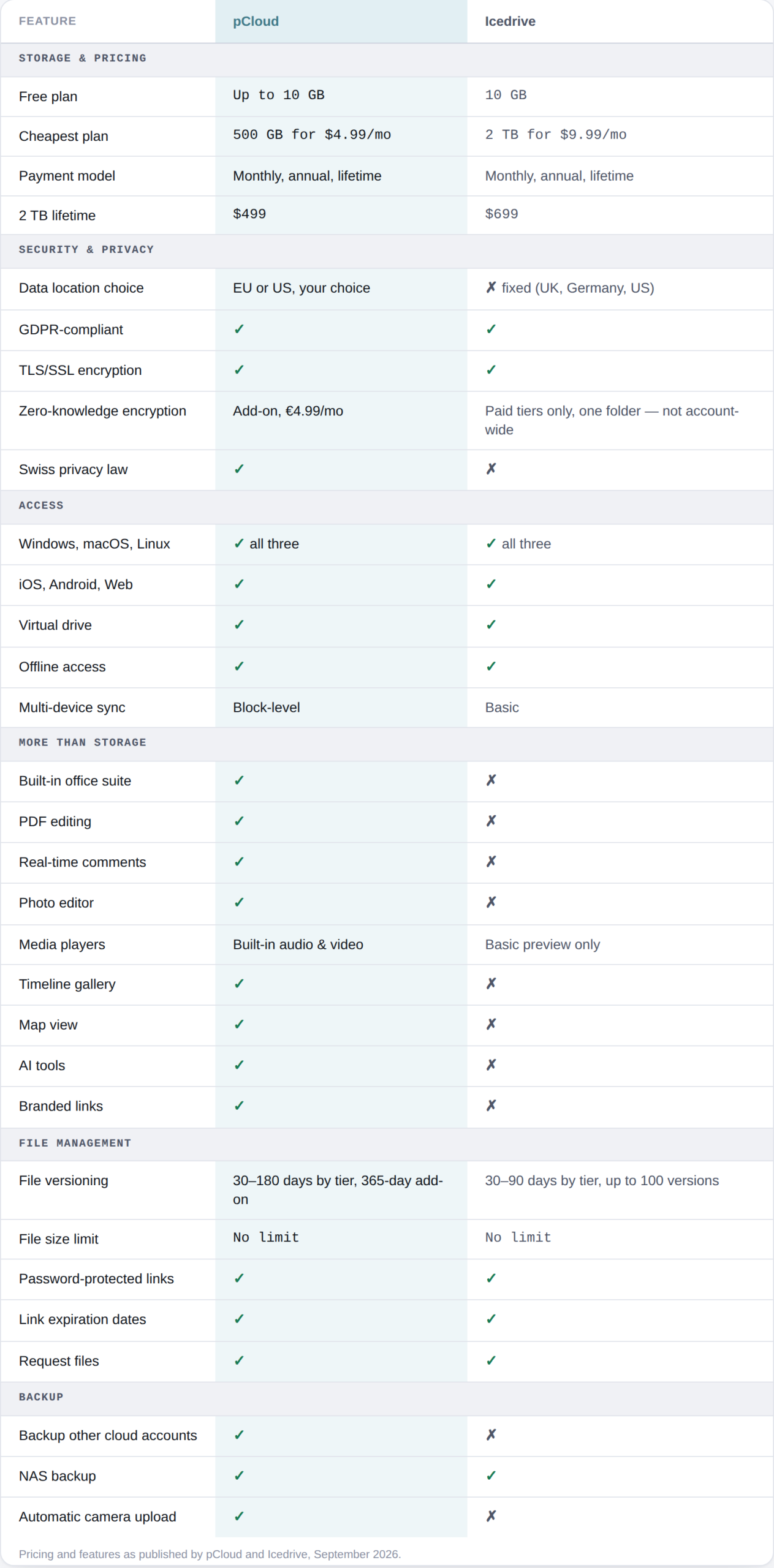
Both providers offer client-side, zero-knowledge encryption. Icedrive includes it on every paid plan by default. pCloud offers it as pCloud Encryption, an optional add-on at $49.99/year or $150 lifetime.
Jurisdiction
Icedrive is operationally based in Wales and corporately registered in Gibraltar. Both are UK-adjacent jurisdictions. The UK is part of the Five Eyes intelligence-sharing alliance and has expansive surveillance powers under the Investigatory Powers Act.
pCloud sits in Baar, Switzerland. Switzerland is not in Five Eyes. Plus, pCloud lets you choose whether your data physically sits in the EU or the US when you sign up. Icedrive doesn’t offer that choice.
Features
Who should choose what?
Icedrive is a perfectly defensible choice if you want an encrypted vault that holds your files and asks nothing else of you. Twofish is a thoughtful cryptographic hedge, zero-knowledge comes standard, and the apps look gorgeous doing very little.
But for almost everyone else, I mean anyone who values:
- speed
- a real media library
- no-account file transfers
- Swiss legal protection
- EU-or-US data residency
- a longer track record
- a lifetime plan that actually costs less per terabyte
… well, pCloud is the better fit.
Of course, he only way to know which one you are is to try it. The first 10 GB on pCloud is free, no credit card or commitment. Time an upload. Stream a song. Share a link without making your friend sign up for anything. Files deserve a good home. Pick the one where yours can actually live.